
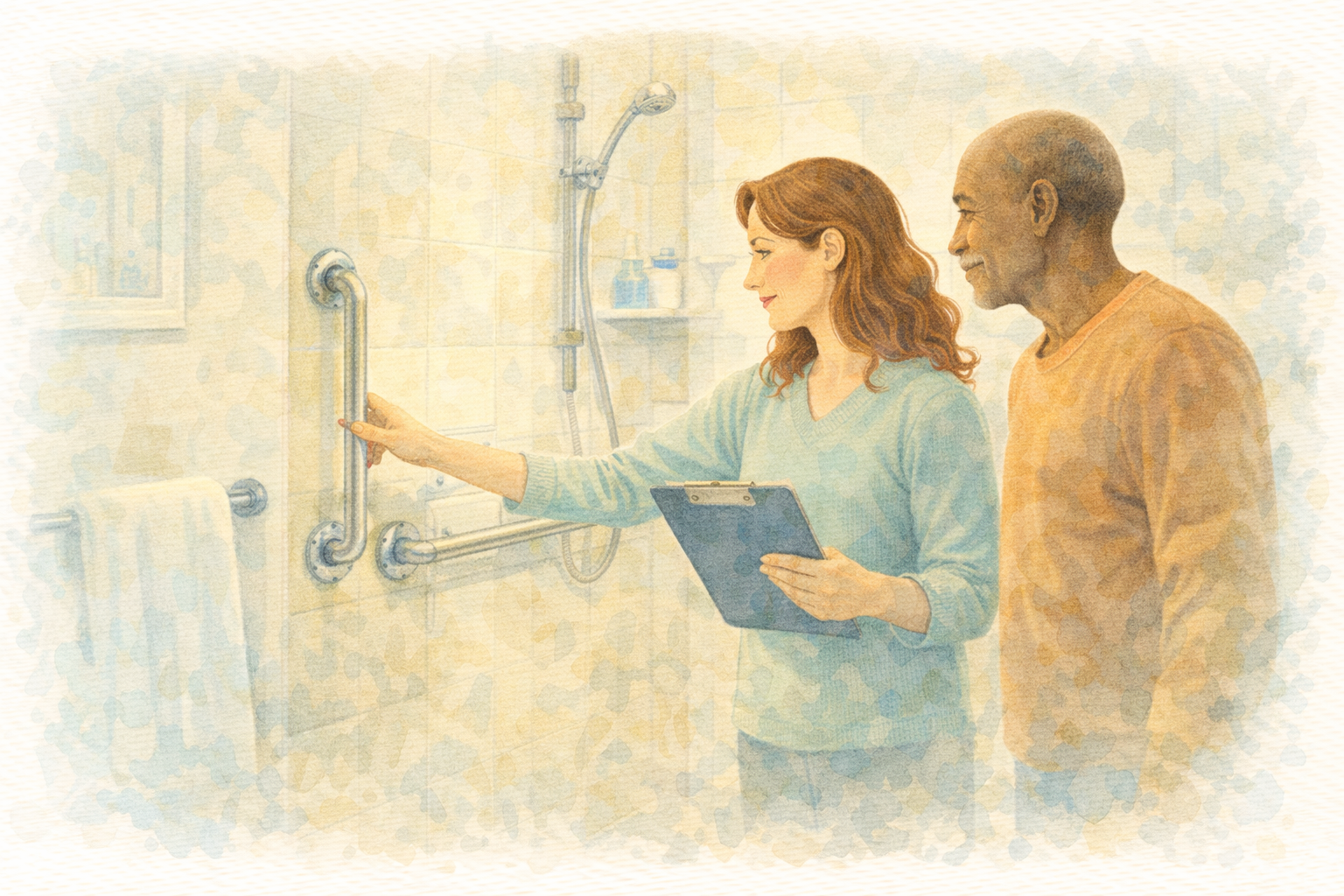
Grab rails can look simple, but the right rail depends on much more than where there is space on the wall. In occupational therapy, grab rail recommendations are based on how a person transfers, where they lose balance, how they use their hands, the bathroom layout, wall structure, and whether the rail is being used for light balance support or stronger body-weight support.
This guide explains the main types of grab rails used in bathrooms, toilets and entry areas, and when an occupational therapy assessment may be needed before installation.
Quick takeaway
The best grab rail is not always the biggest one. It should match the person’s movement pattern, transfer technique, grip strength, vision, balance, and the exact task they are trying to do safely.
Why grab rails should be matched to the person, not just the room
A grab rail may be used to help someone stand from the toilet, step into a shower, steady themselves while washing, move through a doorway, or manage a small threshold. Each task places force through the rail in a different way.
That is why an OT will usually look at the person completing the task before recommending a rail type, position, height or angle. The OT may consider hand placement, whether the person pushes or pulls to stand, dominant hand use, fatigue, pain, reach, balance, transfer style and the layout of the bathroom or doorway.
Australian accessibility guidance such as AS1428.1 can be a helpful reference point for grab rail height and design, but private homes still need individual assessment. What suits a public accessible toilet may not automatically suit one person’s ensuite, shower over bath, older bathroom, or NDIS home modification request.
The main types of grab rails
Horizontal grab rails
Horizontal grab rails are commonly used beside toilets, in showers, and along walls where a person needs steady support. They can help when lowering onto a toilet, pushing up from a seated position, or maintaining balance while standing.
For toilet transfers, a horizontal rail may be useful when the person pushes through the rail to rise or lower with control. The position still needs to match the person’s body size, toilet position, arm reach, shoulder range and transfer method.
Vertical grab rails
Vertical grab rails are often used where a person needs to pull up, steady themselves, or manage a change in level. They may be considered near shower entries, doorways, steps, thresholds, or beside a toilet depending on the person’s movement pattern.
A vertical rail can be helpful when the person naturally reaches forward or upward for support. However, if the person has shoulder pain, weak grip, poor balance, or tends to pull strongly, the OT needs to check whether the rail position is safe and whether the wall can support the required load.
Angled grab rails
Angled grab rails are installed on a diagonal and may support a more natural wrist and forearm position for some people. They can sometimes help when moving from sitting to standing, especially where a straight horizontal rail does not match the person’s movement.
Angled rails are not automatically better than straight rails. The angle, length and location need to be based on how the person actually moves during the task.
Right-angle or L-shaped grab rails
Right-angle rails combine a horizontal and vertical section in one continuous rail. They are commonly considered near toilets or showers when the person needs support for more than one movement, such as pulling forward and then pushing up.
The advantage is that the person can move their hand along one continuous support point, rather than reaching between separate rails. This can reduce gaps and make the transfer feel more predictable.
Fold-down or drop-down toilet rails
Fold-down rails, also called drop-down or hinged rails, are often used beside toilets when there is no suitable side wall for a fixed rail. They can provide support on one or both sides of the toilet and can be folded away when not required.
These rails need careful assessment because they must be fixed into an appropriate wall or frame. They also need enough space for the user, carers, mobility aids and toileting routine.
Floor-to-ceiling rails
A floor-to-ceiling rail may be considered when wall-mounted rails are not suitable or when support is needed away from a wall. These may be used near a bath, bed, chair or other area where the person needs a stable vertical support point.
They are not suitable for every home or every user. Ceiling, floor surface, fixing method, user weight, transfer technique and carer involvement all matter.
Shower grab rails
Shower grab rails may be used to support standing balance, turning, stepping in and out, or moving between standing and a shower chair. In wet areas, the rail finish, grip, contrast, wall strength and tile surface become especially important.
A rail that becomes slippery when wet may not be suitable for someone with reduced grip strength. Some people also benefit from a contrasting rail colour if they have low vision or difficulty seeing white rails against white tiles.
External handrails for steps and entries
Handrails are usually used outside the bathroom, such as at steps, ramps, pathways or entrances. They provide a continuous line of support while walking, stepping or using a ramp.
For people with falls risk, fatigue, reduced balance or mobility aid use, external rails can be just as important as bathroom rails. The OT may assess the entry path, lighting, step height, surfaces, rail continuity and whether the rail supports the person from the start to the end of the movement.
Suction grab rails
Suction grab rails are sometimes sold as a quick option, but they are usually not recommended when a person needs reliable support for transfers or fall prevention. They can loosen, detach, or fail if the surface is not suitable.
If someone is relying on a rail to stop a fall, stand from the toilet, enter the shower, or transfer safely, a fixed rail assessed by an OT and installed by an appropriate tradesperson is usually the safer pathway.
Need a home modification assessment?
Youcentric Care Group provides mobile OT home safety and minor home modification assessments across Sydney and Western Sydney, including grab rail recommendations, bathroom safety reviews and NDIS reporting where required.
What an OT looks at before recommending grab rails
An OT grab rail assessment is not just a measurement visit. It usually looks at the person, the task, and the environment together.
- The person: balance, strength, reach, grip, pain, fatigue, vision, cognition, falls history and confidence.
- The task: toilet transfers, showering, stepping over a hob, entering the home, standing to wash, or moving with a mobility aid.
- The environment: wall type, tile surface, shower layout, toilet location, doorway width, step height, lighting, floor surface and available fixing points.
- The support situation: whether carers assist, whether equipment is used, and whether the person needs independent or supervised transfers.
- The funding pathway: NDIS, aged care, private funding, insurance, or another referral source.
When a grab rail may need a report or written recommendation
A simple private installation may only need an OT recommendation and a suitable tradesperson. For NDIS, aged care or more complex situations, written evidence may be needed to explain why the rail is required, how it relates to safety and function, and why the recommended type and location are appropriate.
For NDIS participants, home modifications are changes to the home that help a person manage disability, safely access the home, move around the home, and complete daily tasks more easily. Depending on the request, the report may need to explain the functional problem, trial or assessment findings, risk, expected benefit, and why the recommendation is reasonable and necessary.
Common referral reasons for grab rail assessments
- Falls or near falls in the bathroom
- Difficulty standing from the toilet
- Unsafe shower entry or shower over bath access
- Reduced balance when washing, dressing or toileting
- Recent hospital discharge or decline in mobility
- Need for minor home modifications under NDIS or aged care funding
- Support coordinator, case manager or family concern about home safety
What to include in a clean referral
If you are referring someone for grab rails or a bathroom safety review, include as much practical information as possible. This helps the OT triage the request and decide whether a basic home safety review, minor home modification assessment, or more detailed report is needed.
- Participant name, address and best contact person
- Funding source, such as NDIS, Home Care Package, CHSP, private or insurer
- Main concern, such as toilet transfers, shower safety, steps or falls risk
- Photos of the bathroom, toilet, shower entry, steps or area of concern if available
- Whether the person uses a walking aid, wheelchair, shower chair, commode or carer support
- Any recent falls, hospital admissions or changes in mobility
- Whether a report, quote, scope of works or recommendation letter is required
Areas we support
Youcentric Care Group provides mobile OT home safety and home modification assessments across Sydney and Western Sydney. If you need a grab rail assessment, bathroom safety review or minor home modification report, we can come to the person’s home and complete the assessment in context.
Need a grab rail or home safety assessment?
Send us the referral details and we can advise whether the person needs a basic home safety review, minor home modification assessment, or a more detailed OT report.
Accuracy note
This article is general information only. Grab rail type, height, angle and fixing should be based on an individual OT assessment, the person’s functional needs, the building structure, and advice from an appropriate installer or tradesperson. For broader guidance, see the NDIS home modifications guideline and Occupational Therapy Australia’s environmental and home modifications FAQ.
NDIS home modifications guideline | Occupational Therapy Australia home modifications FAQ