
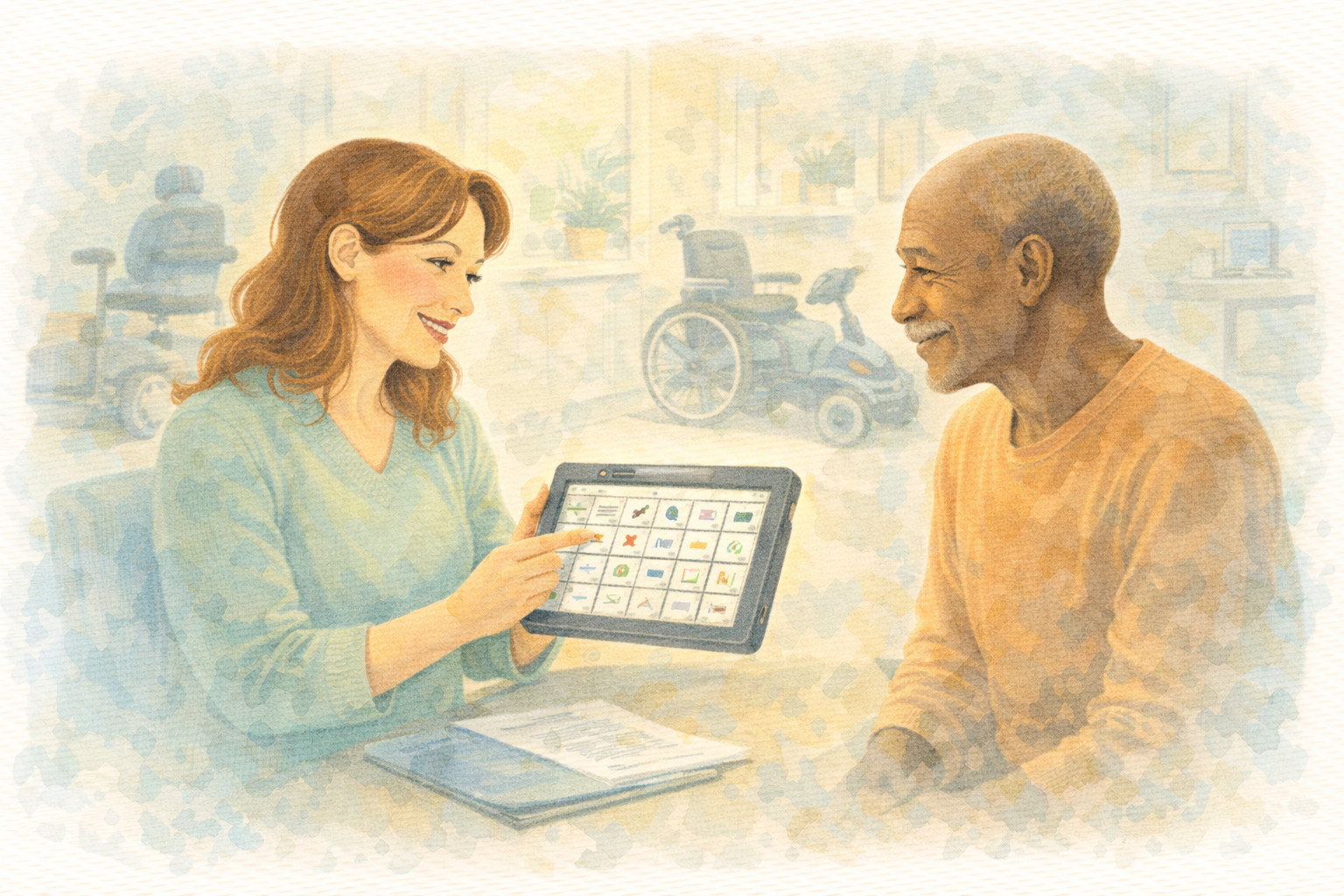
A wheelchair or scooter is one of the most life-changing pieces of equipment the NDIS funds, and one of the most frequently mismatched. The gap between “a wheelchair” and “the right wheelchair for this person, this home and this life” is where an occupational therapy assessment does its work. This guide explains what that assessment covers, why funders require it for significant mobility equipment, and what makes the difference between equipment that gets used daily and equipment that ends up in the garage.
Why mobility equipment needs assessment at all
Because the equipment is configured to a body and a life, not bought off a shelf. Seat width and depth, backrest support, wheel and castor choices, propulsion method, power controls, pressure management, transportability: every one of these is a decision, and a wrong decision is not a minor inconvenience. Poorly fitted wheelchairs produce pressure injuries, postural problems, shoulder overuse and abandonment. Funders require professional assessment for significant mobility equipment because the cost of a wrong chair is paid twice: once in dollars, then again in harm.
What the assessment covers
The person: function, posture and propulsion
Strength, sitting balance, posture, skin integrity risk, endurance across a day, and how the person can realistically propel or control the equipment: self-propulsion, power controls, or attendant push, and with which hand, arm or method. For fluctuating and progressive conditions, the assessment looks at the trajectory, because a chair specified only for today’s function can be outgrown by delivery day.
The day: where the equipment must actually work
A mobility base has to work in the person’s real geography: the home’s doorways and turning spaces, the bathroom circuit, the local footpaths and shops, school or work, and the vehicle it must travel in. We measure the home and check the routes, because the most common equipment failures are geographic: the chair that cannot turn into the bathroom, the scooter that cannot cross the driveway lip, the power chair with nowhere to charge.
The transfers: on and off is half the equipment’s job
Every day with a wheelchair includes getting in and out of it: bed, toilet, shower, car, favourite chair. The assessment maps the person’s transfer methods against the equipment’s configuration, armrests that swing, footplates that clear, seat heights that line up, because equipment that fights the transfers gets abandoned fastest.
The people: carers, pushers and lifters
Where family or workers assist, their capacity is part of the specification: pushing weight, folding and lifting into cars, managing controls. Equipment that injures its second user fails its first one.
The trial: evidence beats brochure
For significant equipment we arrange trials, in the home and on the real routes wherever practicable. An hour of trial answers questions no specification sheet can, and documented trial results, including failures, are some of the strongest funding evidence there is.
What goes to the funder
The assessment produces a prescription and its justification: the functional need, the options considered and why the recommended configuration won, the trial evidence, the fit with home, vehicle and supports, and what happens without the equipment. Supplier quotes are obtained against that specification, not the other way around, and we take nothing from any supplier, so the recommendation serves exactly one interest. Funding decisions belong to the NDIA against its reasonable and necessary criteria, and evidence requirements scale with the cost and complexity of the item, so no honest provider promises approvals. What the assessment controls is whether the request is complete, coherent and anchored in observed function. The wider process is covered on our assistive technology assessments page and in what evidence AT funding needs.
After delivery: fitting, training, review
Delivery day is the middle of the process, not the end. Significant equipment needs fitting and configuration to the person, training for them and anyone who assists, and a review once it has met real life, where footplate heights, cushion choices and control sensitivities get their final adjustments. A large share of abandoned equipment fails in the first weeks for lack of exactly this follow-through, which is why we treat it as part of the prescription.
Frequently asked questions
Manual or power: who decides?
The evidence does. Propulsion capacity across a full day, the terrain the person actually covers, transport realities and the trajectory of the condition all feed the answer, and the assessment documents it so the funder can follow the reasoning. Where either could work, trial results usually settle it.
Can I choose the specific model?
The person’s preferences matter and are part of the assessment; the clinical specification defines what any chosen model must provide. Where a preferred model meets the specification, that is usually straightforward. Where it does not, the report explains the gap so the trade-off is explicit rather than discovered later.
What about repairs, or replacing an old chair?
Repairs and modifications to existing equipment follow a lighter path than new prescriptions, and sometimes the honest finding is that the current chair, adjusted, still fits the need. Replacement requests are strongest when they document what has changed: the person’s function, the equipment’s condition, or the life the equipment has to serve.
How long does the process take, and what does the assessment cost?
Assessment time is charged at the NDIS occupational therapy rate of $193.99 per hour for 2026-27, quoted up front, and our reports are usually delivered within 2 to 3 weeks of the final visit. Supplier trials and quotes add steps for complex equipment, and funding decision timeframes belong to the NDIA, so where a deadline exists, tell us at referral and we sequence around it.
Sources
- NDIS guidance on assistive technology, ndis.gov.au, accessed August 2026. AT funding rules and evidence requirements change; confirm the current position with the NDIA, your planner or your support coordinator.