
What an OT Housing Assessment Covers
Also called an occupational therapy housing assessment or an NDIS housing assessment. What we look at, which report you actually need, the tools we use, and what ends up in the document a decision-maker reads.
Your current home is the evidence
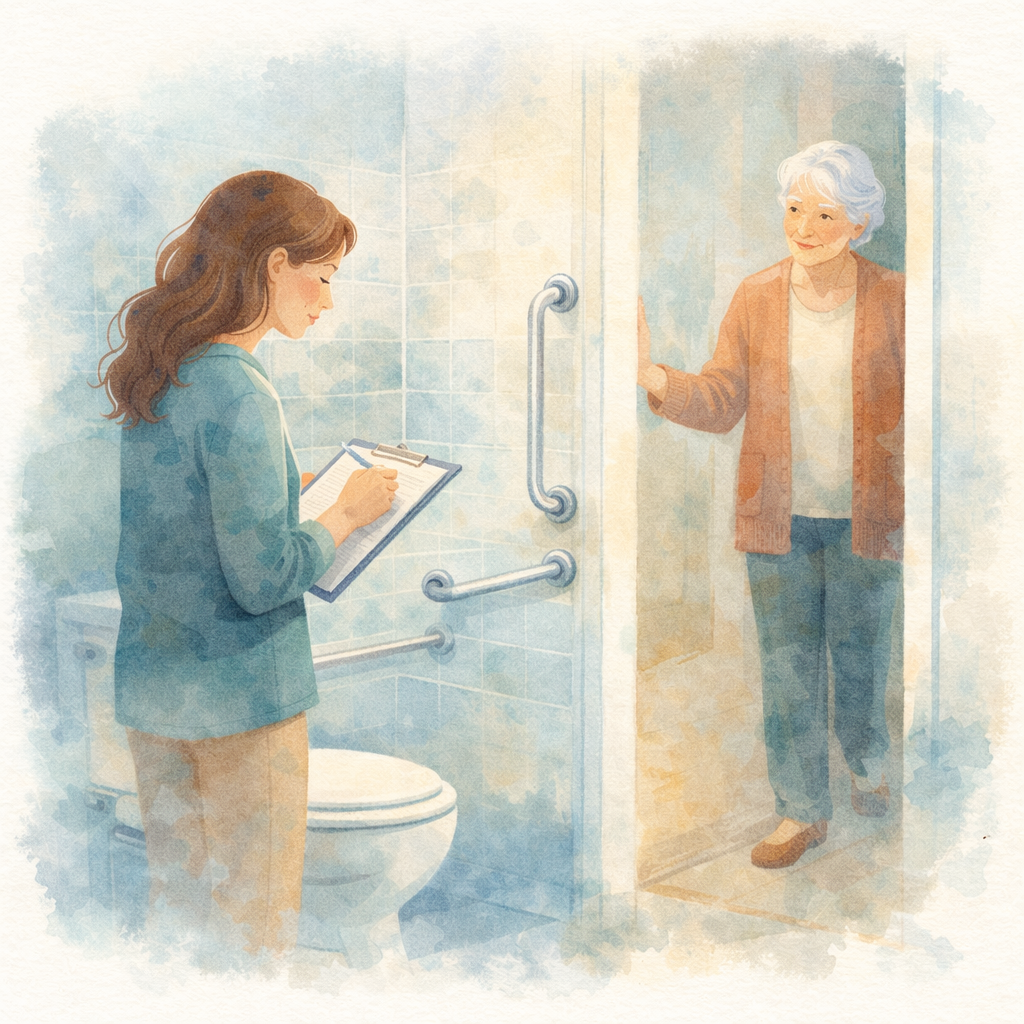
A housing assessment answers a specific question: does the place you live meet your needs, and if not, what would? The reason it happens in your home rather than a clinic is that the failures are physical and particular. A step, a doorway width, a bathroom a wheelchair cannot turn in, a laundry down an external stair.
Those details are what turn a general claim about needing better housing into evidence a delegate can act on. An assessment conducted anywhere other than your home cannot produce them.
The family of housing-related OT reports, and which one you need
People arrive asking for a housing assessment when the thing they actually need has a different name. This is the map.
| Report | Answers the question | Typically when |
|---|---|---|
| Home modification assessment | Can this home be changed to work for you? | The dwelling is broadly right but specific features fail |
| Assistive technology assessment | Would equipment resolve the difficulty? | Before concluding the housing itself is the problem |
| SDA assessment | Do you need purpose-built specialist housing, and of which design category? | Modifications and equipment would not be enough |
| SIL assessment | How much daily support do you need, and in what pattern? | The question is people, not the building |
| ILO assessment | What support arrangement would let you live the way you want? | You want support without a staffed shared house |
| Functional capacity assessment | What can you do, and what support do you need overall? | Access requests, plan reviews, external review |
A good assessment often establishes that a cheaper answer works. If a rail and a level-entry shower resolve the problem, that is a better outcome than specialist housing, and we will say so. See home modifications and assistive technology for those pathways.
The two halves of a housing assessment
You
Self-care, transfers, mobility indoors and out, meal preparation, household tasks, communication, cognition and safety. Observed across a realistic routine rather than asked about.
Overnight and after hours
What happens at night, what support is needed, and what would happen in an emergency. Daytime-only assessments routinely miss this, and it is often decisive.
The dwelling
Entry and exit, doorway and corridor widths, circulation space, bathroom and toilet layout, kitchen usability, floor surfaces, steps and thresholds, laundry and bin access. Measured, not estimated.
Equipment and fit
What assistive technology you use, whether it fits the space, what has been tried and abandoned, and what could not be installed here.
Support arrangements
Who provides support, when, and what informal help family are absorbing. Support that is invisible in the file is support that will not be funded.
Alternatives
Whether modifications, equipment or a different support model would resolve the problem. The NDIA will ask, so the report answers it directly.
Method, and the tools behind it
Observation carries the assessment. Standardised measures anchor it to something a reader can compare against.
We assess across one or two visits, at more than one time of day where fatigue or variability is part of the picture. With your consent we also speak with family, carers, support workers and your treating team, because the people around you see the parts of the week you would not describe to a stranger.
Where they add something, we use validated tools: the WHODAS 2.0 for overall functioning, the COPM for the activities you identify as mattering, and the Lawton IADL Scale for household and community tasks. For children, age-referenced measures such as the Vineland-3 or Pedi-CAT. Tools are chosen to fit the person and the question, not applied as a set.
The measurements of the dwelling matter just as much. A report saying a doorway is too narrow invites a question. A report saying the bathroom door is 720mm against a wheelchair requiring 850mm does not.
What to have ready, and what not to bother with
Useful to have
Your NDIS plan and number, previous OT or allied health reports, specialist letters, a list of equipment you use, and where possible somebody present who sees you day to day.
Please do not
Tidy up, move furniture, or have a good day for our benefit. The obstacles are the evidence. A home arranged for a visitor tells us nothing about the home you actually live in.
What you receive
Your situation and history
Written so somebody who has never met you can follow it.
Functional findings
Area by area, with standardised measures where they add something, explained in plain terms.
What the dwelling does
Specific barriers with measurements, and the consequence of each spelled out rather than listed.
Support needs across 24 hours
Type, intensity and pattern, including the overnight picture and what informal support is currently absorbing.
Housing requirements
What a suitable home would need to provide, and where SDA is in question, the design category the evidence supports and why.
Alternatives considered
Why modifications, equipment or a different support model would or would not resolve it.
After the report is delivered we answer questions from your planner or support coordinator about it, and provide updated evidence if a review requires it. A report nobody can follow up on is worth considerably less than one somebody stands behind.
OT housing assessments: common questions
What is an OT housing assessment?
Is a housing assessment the same as an SDA assessment?
How is it different from a functional capacity assessment?
Do you assess my current home or a proposed one?
What assessment tools do you use?
How long does it take?
What should I have ready?
Who can refer me?
Will you tell me if I do not need one?
Need a housing assessment?
We assess in your own home across Liverpool, Western Sydney and Greater Sydney, and write the report the decision actually needs.
Make a referral or call 1300 316 664An OT housing assessment follows the same method and the same evidence standard. Read our full assessment methodology, including the evidence standard every recommendation is written to.