
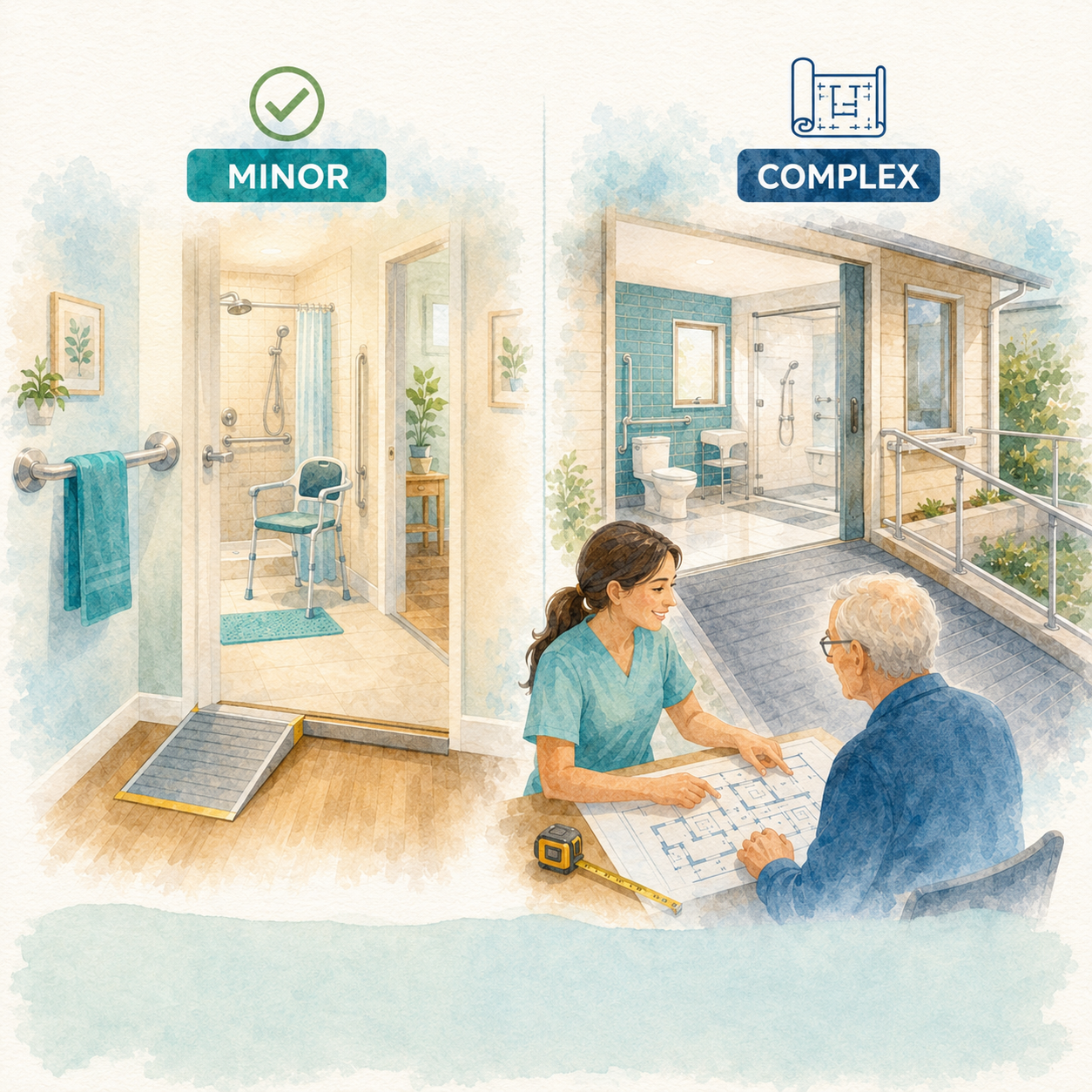
If you are looking at changes to make your home safer and easier to live in, you will often hear two terms: minor and complex home modifications. The difference is simpler than it sounds. This guide explains it in plain English, with real examples, and the occupational therapy assessment you will need for each.
Key takeaways
- Minor home modifications are smaller, non-structural changes, such as grab rails or a threshold ramp.
- Complex home modifications involve structural building work, such as a bathroom redesign or widening a doorway.
- The NDIS also uses cost as part of the definition, with minor modifications under a set threshold and complex ones above it. Figures can change, so confirm the current amounts.
- An occupational therapy assessment is required for both. Complex work needs an OT with extra training and usually a licensed builder involved early.
- Whether anything is funded depends on your plan and goals, so speak with your support coordinator or planner.
What is a home modification?
A home modification is a change to your home that helps you move around, manage everyday tasks, and stay safe. The goal is to match your home to your needs so you can live as independently as possible. An occupational therapist assesses how you manage at home and recommends the changes that will help most.
Minor home modifications
Minor modifications are smaller changes that do not alter the structure of your home. They are usually quicker to arrange and lower in cost.
Common examples include:
- Grab rails in the bathroom or near steps
- Handheld showers and shower seats
- Threshold ramps at doorways
- Lever-style taps and simple rail supports
The NDIS currently groups minor modifications by cost. For the smallest, lowest-cost changes, the process is often simpler and a builder’s quote may not be needed.
Complex home modifications
Complex modifications involve structural building work and are larger in scale and cost.
Common examples include:
- Bathroom redesigns, such as a level-access or wheelchair-accessible bathroom
- Widening doorways or hallways
- Installing a stairlift or a structural ramp
- Any change that affects walls, floors, or the building structure
Because these involve building work, the NDIS expects an occupational therapist with additional training in complex modifications, working closely with a licensed builder from early in the process.
Minor vs complex at a glance
| Minor home modifications | Complex home modifications | |
|---|---|---|
| Scale | Smaller, non-structural | Larger, structural building work |
| Examples | Grab rails, handheld showers, threshold ramps | Bathroom redesigns, widened doorways, stairlifts |
| Cost | Under the NDIS minor threshold | Above the NDIS minor threshold |
| Builder | Often not needed early | Licensed builder involved early |
| OT assessment | Required | Required, by an OT with complex-mods training |
| Timeframe | Generally quicker | Generally longer (design, quotes, build) |
The cost thresholds and rules are set by the NDIS and can change over time. Always confirm the current figures and requirements with your planner or the NDIS.
Why an occupational therapy assessment is needed for both
For any home modification funded through the NDIS, an occupational therapy assessment and report is required, even for something as simple as a grab rail. Your occupational therapist looks at how you manage at home, identifies barriers and safety risks, and recommends the right modifications with clear reasons. For complex work, the report also includes the building detail and justification the NDIS needs to consider the request. You can read more about our home modifications and safety assessments.
A note on NDIS funding
Whether a home modification is funded depends on your individual NDIS plan, your goals, and your circumstances. Funding is not automatic or guaranteed. The best first step is to speak with your support coordinator or NDIS planner, and to have an occupational therapy assessment that sets out what you need and why.
Frequently asked questions
Do I need an OT assessment for something simple like a grab rail?
What makes a modification “complex”?
Who arranges the builder?
Will the NDIS pay for my home modifications?
How long does it take?
Thinking about home modifications?
An occupational therapy assessment is the first step. Youcentric Care Group provides in-home home modifications and safety assessments across Liverpool, Western Sydney and Greater Sydney.