
Key Takeway:
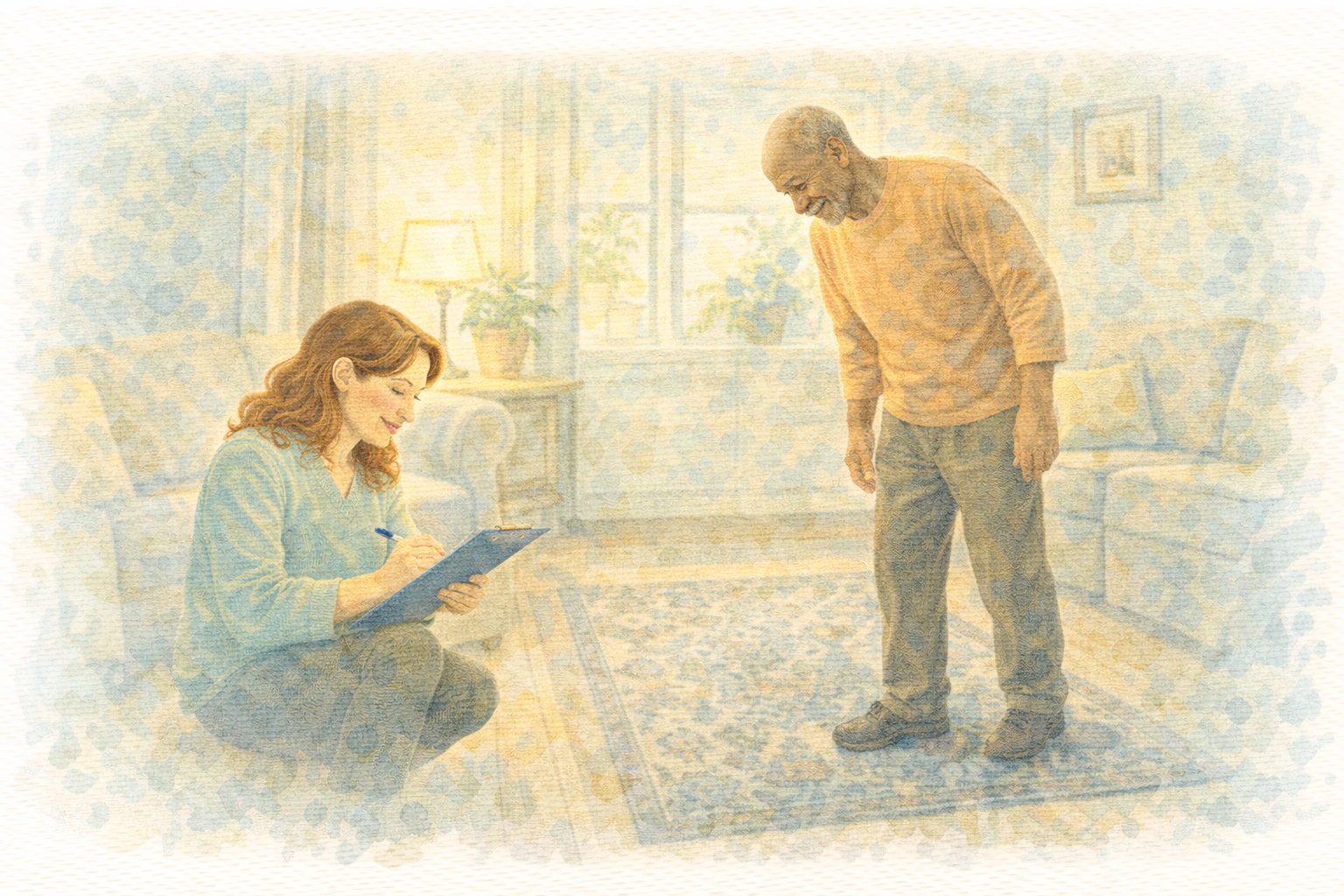
A home OT assessment for falls prevention looks at far more than loose rugs and uneven steps. Your occupational therapist will assess your strength, balance, medications, vision, footwear, and up to 40 individual hazards across every room in your home , then provide a written plan covering both home modifications and personalised therapy goals.
Every year, one in three Australians aged over 65 experiences a fall at home. For most people, it is not one dramatic hazard that causes the fall , it is a combination of smaller risks that quietly build up until one day the conditions are just wrong enough.
An occupational therapist does not simply walk through your house with a generic checklist. They look at how you specifically move through your home , where the gap is between what your body can currently do and what your environment is silently demanding of it. That gap is where falls happen.
Here is what a thorough OT falls prevention assessment actually examines, room by room , and what typically comes out of it
What the OT checks in your bathroom
The bathroom is the highest-risk room in the home. Your OT will assess the step-in height of your shower or bath, the position and grip of any existing rails, and the slip resistance of your floor surface when wet. They will watch how you currently transfer in and out ,what you hold onto, whether you step over a ledge, and how stable you are mid-transfer.
They will also check where your toiletries are stored, whether you are reaching or bending in ways that shift your centre of gravity, and whether your towel rail is being used as a grab rail. Towel rails are not designed to bear body weight , they can pull from the wall without warning and contribute to a fall rather than preventing one.
Common recommendations from the bathroom assessment include grab rail installation at the shower entry and beside the toilet, a shower chair or fold- down bench, a handheld shower head, and a non-slip bath mat rated to Australian Standards. For participants on a Home Care Package or NDIS plan, most of these can be funded directly through your package
What the OT checks in your Bedroom
Bed height is one of the most commonly overlooked fall risks. If a bed is too low, rising requires a forward lean that can cause a loss of balance before you have reached a standing position. If it is too high, you may slide rather than step down. Your OT will measure bed height relative to your hip, watch how you currently rise, and assess whether a bed raiser, different base, or grab rail beside the bed would make transfers safer.
They will also assess the path from your bed to the bathroom during the night , including lighting, floor coverings, and whether you have anything to hold onto if you wake up disoriented. Nighttime falls often happen in the first few seconds after waking, when blood pressure is lower and balance has not yet fully engaged
What the OT checks in your living areas and hallways
Loose rugs, cluttered pathways, low furniture, and poor lighting are the most common hazards in living areas. Your OT will walk every pathway you routinely use , including to the front door, through the kitchen, and to the laundry . and identify where your walking surface changes, where you reach for support, and where you typically pause or rest
Hallways are particularly important. If you reach out and touch the wall when you walk, you are compensating for a balance deficit, and if the wall is not there one day, you are at higher risk. Your OT will flag this and discuss whether a wall-mounted rail, better lighting, or a walking aid would reduce your reliance on the wall
Need a Falls Prevention Assessment?
We visit your home across Liverpool, Bankstown, Campbelltown, Fairfield and surrounding areas. Funded through Home Care Packages, NDIS, or privately.
The personal factors your OT also assesses
A home environment assessment is only half the picture. Your OT will also review your medications, particularly any that affect blood pressure, cause dizziness, or impact balance. Some combinations of medications significantly increase falls risk even when the home environment is perfectly safe.
They will observe how you walk , your gait pattern, stride length, and whether you hesitate before stepping. They will assess your footwear, ask about your vision, and note whether you use a walking aid currently and whether you are using it correctly. Incorrect walking aid height or technique is one of the
more common contributors to falls that people do not expect.
What happens after your OT assessment
Your OT will provide a written report with prioritised recommendations. Some changes can be made immediately at low or no cost , moving a bedside lamp closer, removing a loose mat, repositioning furniture to widen a walking path. Others involve equipment prescriptions, quotes for funded home modifications, or referrals to physiotherapy for a targeted balance and strength program.
If you are on a Home Care Package, your OT can work directly with your Home Care Package provider to action recommendations within your funding. If you are an NDIS participant, your OT can work within your plan and coordinate with your Support Coordinator. The report is written in plain language so that family
members, your GP, and your care team can all understand it and act on it
without needing to start from scratch.
Falls prevention is not a one-off fix. Your OT will discuss a review timeline with you , because what your home needs when you are well is different from what it needs after a hospital stay, a change in medication, or a decline in strength. The goal is a home that keeps pace with you.
Ready to Book a Home Assessment?
We respond to every referral within 1 business day. Our OTs are AHPRA registered and experienced across aged care, NDIS, and private referrals throughout South West Sydney.